 | |
| Photographer: Kevin Carter
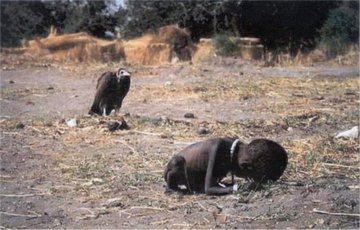
This Pulitzer Prize winning photograph
by Kevin Carter captured the attention of the world by tragically
photographing the desperation that famine was causing in the Sudan. It
was first published in The New York Times and The Mail &
Guardian, a Johannesburg weekly newspaper.
Carter was born in South Africa and was
exposed, at a young age, to the social injustices that the apartheid
created. As he became older, he became increasingly alarmed by the
lack of action or indifference by “decent” men and women. This
had a profound effect on his life and led him to pursue a career in
photojournalism. He spent much of his professional career
photographing social injustices and emergencies.
During his time-off in 1994, Carter
payed his way to photograph the famine in the Sudan. He hoped his
photographs could raise global awareness to the desperation in
Africa, a under-represented geographic location. He was traveling
with the U.N. when this photograph was taken of a child waiting
for her mother to return back from the U.N. food tent.
After this photograph became widely
circulated, Carter received harsh criticism from some who thought he
could have done more and his responsibility to mankind outweighed his
duty to photograph the famine. In his defense, there was not much he
could have done, as the U.N. was visiting many locations to drop off
food and could not have stayed to see if the child survived.
Regardless, the horrors he experienced during his life as a
photojournalist caused him to take his own life shortly after he was
awarded the Pulitzer Prize. "Kevin always carried around the
horror of the work he did," his father, Jimmy Carter, told the
South African Press Association.
This photograph has had such a big impact
primarily because it symbolized the despair of an entire continent.
It became more than a heart-wrenching image of a starving child; it
represented the atrocities that were occurring daily in villages
across Africa. Many people were unaware just how dismal life is for some children in Africa. The vulture in the background seemingly waiting for the child to die, represented the urgency of Carter's message. This photo was meant to be shocking and alarming as it was necessary to facilitate immediate action from the world.
|
Showing posts with label read mrm. Show all posts
Showing posts with label read mrm. Show all posts
Wednesday, November 28, 2012
Kevin Carter: Sudan Famine

Monday, November 26, 2012
The Falling Man
An image so shocking that many were angry and disturbed. People criticized newspapers when they ran the photograph. Newspapers no longer ran the photograph because of the complaints of exploiting a man's death. It was to be known as the "most famous photograph no one has seen". The self-censorship couldn’t wipe the Falling
Man image and the 9/11 attacks from my collective memory. It is a photograph I remember in the newspapers the next day after watching the attacks on TV with my parents and brother.

This photograph was taken by Richard Drew, an Associated Press photojournalist at 9:41 am on September 11, 2001. Richard Drew was only twenty-one years old when he saw and photographed the assassination of Robert Kennedy. Drew, now fifty-four years old, was dispatched by his editor to take photos of what was unfolding at the World Trade Center. He began to take a series of photographs of those who were jumping. The subject of this image was one of the many people who were trapped above on the upper floors of the Twin Towers because of the fire and smoke. At least two hundred people fell or jumped to escape the unbearable heat and smoke.

Photograph by Richard Drew for the Associated Press
This photograph was taken by Richard Drew, an Associated Press photojournalist at 9:41 am on September 11, 2001. Richard Drew was only twenty-one years old when he saw and photographed the assassination of Robert Kennedy. Drew, now fifty-four years old, was dispatched by his editor to take photos of what was unfolding at the World Trade Center. He began to take a series of photographs of those who were jumping. The subject of this image was one of the many people who were trapped above on the upper floors of the Twin Towers because of the fire and smoke. At least two hundred people fell or jumped to escape the unbearable heat and smoke.
While it is not a grotesque image, it has a shock value to it. This image is one of a series photographs taken of this subject. The image shows a man falling straight down while the other eleven photographs show him tumbling through the air. He is perfectly vertical as if he is flying. It is a quiet and an imitate image of a man that encapsulated the day’s horror. Drew's photograph became at once iconic, yet its subject remained unnamed. The photograph was run only once in the Times. The identity of the man has not been confirmed because of the many people who fell that day. Suggestions have been made through the years of who it may be, but I will leave that out of this post out of respect because it is only speculation.
Reference: Esquire Article
Reference: Esquire Article
Elizabeth Eckford, Hazel Bryan and the Little Rock Nine

Taken by Will Counts on September 4th, 1957
On September 4th, 1957, Elizabeth
Eckford, one of the Little Rock Nine, made her way to the first day of school
at Little Rock Central High School. Although Brown v. Board of Education passed
in 1954, it took three years to enroll the eventual nine students. “As the new school
year loomed, segregationist groups and fundamentalist clergy mobilized”. [2]
The night before September 4th, NAACP director of the Arkansas
chapter Daisy Bates instructed the parents to bring the nine children to her
home the next morning where they would go to Central as a group accompanied by
a few ministers. The Eckford household did not have a phone so they were not
notified.
Hundreds of protesters had arrived that morning as
Elizabeth tried to get into the school only to be rebuffed three times. Horrific
obscenities were shouted at her, she was spat on and she was surrounded. Her
main priority now was to get to a bus station a block away and to once again
gain some semblance of feeling safe.
As Eckford made her way back to the bus station,
26-year old Will Counts, photographer for the Arkansas Democrat was capturing
all of this with his camera.
The stoic, shy and shaken Elizabeth forms one half
of the diametrically opposed iconographic duo. The other half belongs to Hazel
Bryan, a fifteen-year old also about to begin her junior year. She is describes in Vanity Fair’s “Through a
Lens, Darkly” as a young girl who was always a bit of a performer who blindly
took after her father’s prejudice. The moment Will Counts snapped this photo is
when Hazel reportedly shouted ‘Go home nigger! Go back to Africa!’ The photo
appeared in the afternoon’s Arkansas Democrat and within a couple of weeks, the
photograph made its way around the world.
The Vanity Fair article goes in depth into the
before and after of the photo; how the individual lives were affected in the
long and short term and the impact the photo had on the world. The outrage
instigated by the photograph ‘proved a national embarrassment’ and a new date
was set for September 23rd. They were able to get into the school
this time but the experience would prove a miserable one filled with constant
isolation and constant harassment.
The dichotomy the picture presents is crystal clear
and the perfection of the moment makes its immediate symbolic resonance all the
more powerful. People in 1957 could look at this photo and see a purified emotive
version of the complicit prejudice they surrounded themselves with every day. Sontag
specifies the photographic medium, stating that “in contrast to a written
account which, depending on its complexity of thought, references, and
vocabulary, is pitched at a larger or smaller readership, a photograph has only
one language and is potentially destined for all.” [1].
Sontag’s statement rings true in regards to the
Eckford/Bryan photo. Both Eckford and Bryan became defined by this photo,
forever living in the shadow of something involuntarily bigger than them. The
reason for that is because sometimes one needs to see the visceral
unadulterated hatred so incomparable on Bryan’s face to get the message and to start asking themselves some very important questions. It may
seem obvious to us now, but in a different time it might have taken something
like this to wake some people up. In contrast, Eckford is trying to keep a calm
collected composure as she makes her way to that bus station. It is taking everything she has for that stoicism to come across and her inner strength is palpable. This picture, and
all pictures, are famous because of the ‘moment’ they capture; the split second
that immortalizes what becomes unattainable for us at each passing flicker. The
hatred so evident in Hazel’s face is not just one girl’s misguided passion. In
this idea of becoming much bigger than oneself, that face, that emotion and the
immediacy and purity of it came to represent the whole of racial prejudice.
Photographs have the power to become that broadly representative and this photo
is an example of that.
Works Cited:
Sontag, Susan, "Looking At War." The New Yorker (12 September 2002), 4.
Margolick, David. "Through a Lens, Darkly." Vanity Fair (27 September 2007)
Robert Capa's "D-Day, Omaha Beach, 1944"
In the June 19, 1944, issue of LIFE magazine, eleven of Robert Capa's images of the Normandy invasion were published. The picture below is one of them:
As a little girl, I would listen to the gripping stories that my grandfather would tell about D-Day and his following years in the United States Army. It wasn't until I was older and saw this set of photographs, specifically the one above, that I felt even a small fraction of understanding of what it must have been like to go through an event like this. The blurred motion in the photograph gives me goosebumps, as I can imagine the sound and feeling of the earth shaking bombardments.
Robert Capa once said, "If your pictures aren't good enough, you're not close enough." Capa was killed after stepping on a landmine in Vietnam, while he was photographing French troops on a mission. According to Sontag, " Photographs of mutilated bodies...may bring home, for a spell, a portion of its reality to those who have no experience of war at all."
He also paved the way for other photographers to go into the fray. War photographers like Tim Hetherington, who died covering the civil war in Libya, earlier in 2012.
Sontag's "Looking at War" article also mentions Capa. Her article also talks about the desensitization of war through the pertinence of images. While I agree with this view, I do not think it pertained to this time period. Robert Capa made it possible for the American citizens at home to see what their troops abroad were experiencing.
Resources:
http://www.huffingtonpost.com/mobileweb/david-schonauer/hetherington-hondros-war-photojournalists_b_852546.html
 |
D-Day, Omaha Beach, 1944, Robert Capa picture (via LIFE) |
Robert Capa once said, "If your pictures aren't good enough, you're not close enough." Capa was killed after stepping on a landmine in Vietnam, while he was photographing French troops on a mission. According to Sontag, " Photographs of mutilated bodies...may bring home, for a spell, a portion of its reality to those who have no experience of war at all."
He also paved the way for other photographers to go into the fray. War photographers like Tim Hetherington, who died covering the civil war in Libya, earlier in 2012.
Sontag's "Looking at War" article also mentions Capa. Her article also talks about the desensitization of war through the pertinence of images. While I agree with this view, I do not think it pertained to this time period. Robert Capa made it possible for the American citizens at home to see what their troops abroad were experiencing.
Resources:
http://www.huffingtonpost.com/mobileweb/david-schonauer/hetherington-hondros-war-photojournalists_b_852546.html
Sharbat Gula, the Afghan Girl

Steve McCurry, Afghan Girl, near Peshwar, Pakistan (1984)
Steve McCurry took this iconic portrait of "the Afghan girl," in December 1985. McCurry, a photographer for National Geographic, had been sent to the Nasir Bagh refugee camp in Pakistan to document the suffering of the Afghan people as a result of the Soviet occupation of Afghanistan. At the time, "a quarter of Afghanistan’s prewar population of about 15 million [had] been forced into exile in neighboring Pakistan and Iran. At least another million [were] 'internal refugees,' driven from their homes by bombing and other military action."[1] This hauntingly beautiful photograph portrays Sharbat Gula, a young girl, who had fled to the refugee camp with her grandmother and four siblings after a bomb had destroyed her home and killed her parents.
In an interview with Phaidon at the Chris Beetles Fine Photos Gallery, McCurry recalled his initial reaction upon entering the school tent in the refugee camp:
"When I walked into the classroom I was kind of convinced that she was really an amazing person but she was very shy...I started off by photographing the other students, because I thought if I approach her straight away and she says 'no' that would be a no for the rest of the day. So I photographed her classmates and got them involved in the process. I wanted her to feel that she was almost excluded so that she'd want to take part in it and, sure enough, it got to the point where she agreed."
In this same interview, McCurry goes on to explain how "there's a real emotion and a real beauty in the picture. Her expression is ambiguous...she has a rip in her shawl and her face is kind of dirty. But through that there's a dignity and there's a perseverance and a fortitude. There's a wide range of emotions. I think there’s a great depth to the picture."[2]
The photograph, indeed, captured the attention of many. The photograph was used on the cover for the June 1985 issue of National Geographic, and became a symbol of the Afghan conflict in the 1980s and of the terrible ordeal of refugees worldwide. To honor Sharbat Gula, National Geographic established the Afghan Children's Fund, a charity to help provide education for Afghan children. The image of the "Afghan Girl," inspired the world to recognize the extent of the damage occurring in Afghanistan. Without the blood, explosions, and devastated buildings, the photograph still speaks to the tragedy and consequences of war through Gula's expression and piercing eyes.
The power of this portrait stems from the simple composition, and from our human compassion towards this young girl that stares out so fiercely. We react to her eyes, and understand that we have not seen what she has seen. In fact, the photograph tells us almost nothing about her. And yet, we feel that she has struggled. The image reflects the cruelty of the world, and also maintains an aesthetic quality that captivates the viewer. In "Looking at War," Sontag writes:
"Transforming is what art does, but photography that bear witness to the calamitous and the reprehensible is much criticized if it seems 'aesthetic': that is, too much like art. The dual powers of photography - to generate documents and to create works of visual art - have produces some remarkable exaggerations about what photographers ought or ought not to do. These days, most exaggeration is of the puritanical kind. In this view, a beautiful photograph drains attention from the sobering subject and turns it toward the medium itself, inviting the viewer to look "aesthetically," and thereby compromising the picture's status as a document. The photograph gives mixed signals. Stop this, it urges. But its also exclaims, What a Spectacle!"
The photograph does just this. It exposes the viewer to the consequences of war, while also expressing a stunning portrait of human resilience and survival. Should it be criticized for that? In "Looking At War," Sontag continues to emphasize the power of photographs that maintain this duality of emotions. The photograph is both beautiful and tragic. The image below further emphasize how emotion can be illustrated in documentary portraiture. Here we see Gula in 1984 and in 2002. Her expression is still as cold and distant as it was when she was young. There is a strong sense that both photographs capture the essence of who she is and where she comes from.

Steve McCurry, Sharbat Gula in 1984 and 2002
"We truly can't imagine what it is like. We can't imagine how dreadful, how terrifying war is - and how normal it becomes."
-Susan Sontag

Steve McCurry, Sharbat Gula with National Geographic Cover, 2002
Works Cited
Denker, Debra. "A Life Revealed: Along Afghanistan's War-torn Frontier." National Geographic April (2002). Accessed November 25, 2012. http://ngm.nationalgeographic.com/2002/04/afghan-girl/original-story-text.
Rubin, Elizabeth. "Veiled Rebellion." National Geographic December (2010). Accessed November 25, 2012. http://ngm.nationalgeographic.com/2010/12/afghan-women/rubin-text.
Sontag, Susan. "Looking at War." The New Yorker December (2002): 1-19.
"Revealed - the true story behind the 'Afghan Mona Lisa'." Phaidon September (2011). Accessed November 25, 2012. http://www.phaidon.com/agenda/photography/events/2011/september/07/revealed-the-true-story-behind-the-afghan-mona-lisa/.
Jacqueline Kennedy stands next to Lyndon Johnson
 |
| Cecil Stoughton. White House Photographs. John F. Kennedy Presidential Library and Museum, Boston. |
Stoughton didn't catch anything shocking with this photograph, but to a nation trying to come to grips with a tragedy this made an event that must have seemed unreal a reality, John F. Kennedy was dead and the nation had a new president. This supports the idea that Sontag raises that seeing photographs make an event more "real" (p.16). For the American people seeing this photograph was likely what made the events of that day more real than anything.
In this image you see not the kind of suffering that soldiers or civilians encounter during war that Sontag writes about in her essay, "Looking at War", but this photograph captures the suffering of a nation over the loss of a man through whom many held a collective hope for the future of a nation. Though Johnson would later sign into law many bills that supported JFK's legacy, like the Civil Rights Act of 1964, for many of the American people November 22, 1963 is still cited as the day a dream died. If you ask those who were alive that day some will still lament what could have been if Kennedy had completed his term (or terms) in the White House.
Charles Porter's Pulitzer Prize Winning Photo at the Oklahoma City Bombing
 |
| Firefighter Cradling Infant Victim of Oklahoma City Bombing by Charles Porter IV. April 19, 1995. Spot News Photography, Associated Press.
On April 19, 1995, a bomb exploded at the Alfred P. Murrah Federal Building in Oklahoma City. Charles Porter, the photographer of the above photograph, was working a few blocks away when he heard the rumbling form the explosion. He thought there might be construction occurring and he grabbed his camera that he kept in the trunk of his car and ran to the site of the noise. As an aspiring photographer, he hoped to take some interesting shots, but he had no idea what he was about to encounter. In the ensuing chaos, he snapped pictures at everything he saw, starting with the crumbling Federal Building. At one point, as he was taking photos of a woman receiving medical care, he saw movement out of the corner of his eye. A policeman, holding something in his arms, was running toward a fireman. Charles took a photograph of the policeman handing what he realized was a young child, to the firefighter. This first frame by Charles Porter is seen below:

Then, the firefighter removed his gloves, turned and Porter saw the baby clearly in his arms. He took a picture, but at the time, had no idea if it would be a good photograph or if it would even be clear because of the smoke in the air. Both the firefighter, later identified as Chris Fields, and Porter did not know at the time of the photo that the child was already dead.
After taking the photo, Porter went to a nearby hospital and searched for the infant, to no avail. Then, he took his photos to Wal-Mart to have them developed. He said the first time he realized he might have a strong photograph was when the photo clerk paused at one picture and began crying. After seeing the pictures himself, and showing them to a friend, the friend recommended Porter send them to the Associated Press office in Oklahoma City. Within a few hours, Wendel Hudson, the AP photo editor in Oklahoma City, received the photo, realized its potential, and sent it out on the AP wire. Porter received a phone call from a reporter at The London Times who asked him, "Could I get your reaction and response to what your feelings are going to be, knowing that your image is going to be over every newspaper and every magazine in the entire world tomorrow?" Before that call, Porter thought one of his photos might end up in the local paper, but now his dream of becoming a photojournalist had been realized.

To the left is a picture of Charles Porter, holding the front page of Tulsa World with his photograph on the front. Immediately after his photo was shown worldwide, Porter could not pick up his camera again. He felt sick that his fame was growing when the family of the infant, now known as Baylee Almon, was grieving the loss of their one-year-old daughter. A few days after the bombing, he met with Baylee Almon's mother, who told him the image did not cause her extra pain. In fact, she felt relieved that there was evidence of the care she was given. Also, she was able to begin grieving immediately because their daughter was found and identified so soon, rather than having to wait like many other families. For the family then, this picture's fame brought relief.
Indeed, the photo was immensely popular. As the woman from The London Times told Porter, the photo would be on covers and in newspapers across the world. A year later, in 1996, the photo also received an extremely high honor - the Pulitzer Prize. Charles Porter went from obscurity to infamy in an extremely short time because of this one photograph.
Why was it so popular? In the article, "Looking at War," Susan Sontag sheds some light on this. She wrote that photos of mutilated bodies can not only bring home the realities of war, but also serve to condemn the responsible parties (3). Because of the grotesque nature of Baylee Almon's bleeding, lifeless body, this photo appalled viewers and automatically made them sympathetic to the victims. Attacks like this which target innocent civilians are always difficult to comprehend, and images like this show the horrors of terrorism. 168 people were killed that day, including Baylee Almon, but her image serves as the symbol for them all, and her death is much more violent as she was taken from her parents so prematurely. After looking at this photo, regardless of the reasons for or context behind the bombing, the perpetrator(s) are labelled as evil and condemned. The perpetrator in this case, Timothy McVeigh, was indeed caught, convicted, and then executed for his crimes on June 11, 2001.
In my opinion, this photo also has extreme power because it was taken by an ordinary photographer, not a photojournalist sent to record the destruction. Charles Porter took the photos and got them developed at a local Wal-Mart, and then sent them to the AP without editing them. Because of this, the photo is thought to be more realistic, more honest because it could have been taken by anyone. That also gives it more emotional power, as viewers look at the photo and imagine themselves at the scene, witnessing that moment, just as Charles Porter did. That's a powerful feeling.
Sources:
The Newseum, Permanent Exhibit: Pulitzer Prize Photographs Gallery: http://www.newseum.org/exhibits-and-theaters/permanent-exhibits/pulitzer/videos/1996-spot-news-charles-porter--the-associated-press.html
BBC World Service Programme, The World Today: http://news.bbc.co.uk/2/hi/americas/4529389.stm
Associated Press Pulitzer Prize Photograph List: http://www.ap.org/company/pulitzers
Prodis, Julia, "Amateur Photographer Takes 'Photo Felt Around the World.'" Associated Press, (23 April1995): http://www.apnewsarchive.com/1995/Amateur-Photographer-Takes-Photo-Felt-Around-the-World-/id-7871f59d269d4539aedd11042039e3b0?SearchText=oklahoma%20city%20bombing%20charles%20porter%20photo;Display_
Associated Press, "Porter Wins Pulitzer for Bombing Photos Moved by AP" (9 April 1996): http://www.apnewsarchive.com/1996/Porter-Wins-Pulitzer-for-Bombing-Photos-Moved-by-AP/id-400560e842893655ed970d3268d16633?SearchText=oklahoma%20city%20bombing%20charles%20porter;Display_
Famous Pictures Magazine Blog, "Oklahoma City Bombing": http://www.famouspictures.org/mag/index.php?title=Oklahoma_City_Bombing
The Indianapolis Star, "The Oklahoma City Bombing" (2003): http://www2.indystar.com/library/factfiles/crime/national/1995/oklahoma_city_bombing/ok.html
Sontag, Susan, "Looking At War." The New Yorker (12 September 2002), 3.
|
Che Guevara
 |
| Alberto Korda, 1928-2001. Che Guevara, March 5, 1960. |
The image of Che Guevara is still almost ubiquitous
forty-five years after his death. The handsome young man in a dark beret
adorned with a single bright star above his forehead, with thick black curls
surrounding his face, and an intense and unforgettable gaze up into the
distance has captured the imagination and aspirations of millions of people of
several generations. This photograph of Che has become an iconic image and is
considered by many to be the most famous photograph in the world. At first, it
synthesized and epitomized in a single image the Marxist ideology that Che
Guevara and Fidel Castro espoused; later its message was adopted and adapted by
others to symbolize and express their own vastly different hopes and dreams.
In order to understand the initial impact of this image
after his death, it is essential to understand who Che Guevara was. Born in a
middle-class family in Argentina in 1928, Ernesto “Che” Guevara was a physician
who became inspired by the idea of social change and gave up status and power
to pursue his beliefs. He became a Marxist revolutionary and took part in Fidel
Castro’s guerrilla struggle in Cuba’s Sierra Maestra against the regime of
Fulgencio Batista. Following the success of the socialist revolution in Cuba,
Che was first appointed commander of a military prison. Soon after that, he served
as president of the National Bank of Cuba and later as minister of industry.
His revolutionary spirit led him away from Cuba to the Congo and later to
Bolivia, where he engaged in guerrilla warfare against the local regimes. On
October 9, 1967, he was captured and killed by Bolivian forces, apparently in secret
collaboration with the CIA.
The photographer who took this most famous photograph (although
he was not aware of its impact at the time) was Alberto Korda. Born as Alberto
Gutierrez Diaz in Cuba in the same year as Che Guevara, he adopted early as his last
name that of the Hungarian film-maker Alexander Korda. He studied journalism
and established a photographic studio in Havana in the 1950s. Korda was an
earnest sympathizer of Castro’s new socialist government and accepted a
position as his photographer at official events.

On March 5, 1960, during a speech by Fidel Castro at the
funeral of victims of a French boat explosion in Havana harbor (blamed by Cuba
on a U.S.-instigated act of sabotage), Korda snapped two photos of Che Guevara.
Reminiscing about the exact moment of taking those photos, Korda explained
years later: “I decided to watch from the crowd and used my Leica with its
medium telephoto lens. I planned the podium and suddenly Che moved forward into
my camera. I made a picture, and immediately thinking for a cover of our
newspaper, turned the camera vertical, made another – and the moment had gone.”
(“Alberto Korda”). The photographer was working on an assignment for the
newspaper “Revolucion.” When reviewing his work at the studio, Korda found the
first photo particularly impressive, so he cropped it and printed it as a
portrait. He named the photo Guerrillero Heroico. Although the newspaper did
not publish it, he later offered copies of it as a gift to Italian left-wing publisher
Giangiacomo Feltrinelli as an illustration for an upcoming book.
The photograph lay dormant until Che’s death on October 9,
1967, when it became the most sought-after image of him. It became an object of
inspiration and veneration for millions of people in South and Central America,
where he was considered a martyr. Ever since the night when Fidel Castro
announced Che’s murder in a speech at the Plaza de la Revolucion in Havana, a
monumental banner with Korda’s portrait of Che has adorned the wall of the
ten-story Ministry of the Interior building there. As soon as the news of Che’s
murder reached Europe, Feltrinelli released Korda’s photograph of Che in the
form of a poster. In a very short time, it reached all corners of the world. It
was posted in homes and public places and was soon transferred to t-shirts.
 |
| Jim Fitzpatrick and his famous silkscreen portrait of Che. |
In 1968, the Irish artist Jim Fitzpatrick created a
black-on-red silkscreen image of Che Guevara based on Korda’s photograph. He
employed the “line drop” process, outlining the image of Che in black against a
red background, and hand-coloring the star in yellow. This portrait became not
only his most famous work, but ultimately one of the most famous iconic images
of all time. Fitzpatrick had the opportunity to meet Che Guevara during the
latter’s visit to Ireland in 1962. Inspired by Che’s ideas and by his
martyrdom, Fitzpatrick disseminated his silkscreen portrait of Che for free,
with his only desire being to ensure that his hero’s memory would live on
(Tipton).
Korda’s photograph and its derivative images attracted
widespread attention and gave many young people a visual image that encapsulated
their desires for social reform. Che possessed many features that helped his
image to become an icon: he was both young and handsome, invoking love and
adoration in the hearts of millions; he abandoned a comfortable life and
considerable status to follow his ideals, and he became a revolutionary not
only in words but also in deeds, thus providing a moral example for many who
aspire for social reform and justice; he died young, which fixed his image as
that of a heroic martyred revolutionary. Korda’s photograph captured
magnificently many of those features in the expression of his face and in the
determination of his fiery gaze off into the distance.
 |
| Death picture of Che Guevara, October 9, 1967. |
 Ironically, given the atheistic nature of Communism, Korda’s
photograph of Che has taken on the role not only of a secular icon, but also a
religious one. Even his beret could be perceived as a partial halo around his
head. The religious connotation of Korda’s photograph was reinforced at the
time by another image of Che Guevara taken right after his death—that of his
body propped up on a stretcher on top of a cement surface in a stable and
surrounded by soldiers and journalists. This unforgettable image “not only
summed up the bitter realities of contemporary Latin American history,” but also
resembled the 15th-century foreshortened image of The Dead Christ by Andrea Mantegna and
Rembrandt’s The Anatomy Lesson of
Professor Tulp (Sontag, 107). In adherence to local belief in the
miraculous powers of those who die tragically, thousands of photographs of Che
were sold in Bolivia in the days after his death and displayed in homes next to
images of Christ and the Virgin. The religious appeal of Che’s photograph
spread throughout Latin America and Cuba (Goldberg, 159).
Ironically, given the atheistic nature of Communism, Korda’s
photograph of Che has taken on the role not only of a secular icon, but also a
religious one. Even his beret could be perceived as a partial halo around his
head. The religious connotation of Korda’s photograph was reinforced at the
time by another image of Che Guevara taken right after his death—that of his
body propped up on a stretcher on top of a cement surface in a stable and
surrounded by soldiers and journalists. This unforgettable image “not only
summed up the bitter realities of contemporary Latin American history,” but also
resembled the 15th-century foreshortened image of The Dead Christ by Andrea Mantegna and
Rembrandt’s The Anatomy Lesson of
Professor Tulp (Sontag, 107). In adherence to local belief in the
miraculous powers of those who die tragically, thousands of photographs of Che
were sold in Bolivia in the days after his death and displayed in homes next to
images of Christ and the Virgin. The religious appeal of Che’s photograph
spread throughout Latin America and Cuba (Goldberg, 159). 
However, not everyone agrees that Che was a saint or even a
hero. Some representations also based on Korda’s photograph or stylized
versions of it depict him as ruthless and bloodthirsty and strive to disclose
dark truths about his life that are little known by some who aspire to his
example. For example, anti-Communists modify Fitzpatrick’s image, replacing
Che’s face with that of Hitler or of Death (a skull), or drawing a circle
around Che’s head and canceling it out with a diagonal line.


 Finally, it is remarkable and ironic to observe how the
image of this anti-capitalist revolutionary has become a source of income for
enterprising capitalists. His image has been emblazoned on posters, t-shirts,
mugs, coasters, tattoos, socks, pins, hats, etc. One wonders to what degree the
later generations who have no direct connection with him or his time are aware
of the image’s original Marxist appeal. Some studies show that “the memory of
revolutionary figures can retain their antisystemic appeal even in the face of
pervasive commodification” and that such is the case with the image of Che
Guevara, the iconic significance of which has retained its power to stand for the
“political struggles of oppositional groups” (Larson and Lizardo, 449). Its enduring
– and adaptable -- iconic power is demonstrated by its use in the recent
Egyptian uprising and other demonstrations around the world.
Finally, it is remarkable and ironic to observe how the
image of this anti-capitalist revolutionary has become a source of income for
enterprising capitalists. His image has been emblazoned on posters, t-shirts,
mugs, coasters, tattoos, socks, pins, hats, etc. One wonders to what degree the
later generations who have no direct connection with him or his time are aware
of the image’s original Marxist appeal. Some studies show that “the memory of
revolutionary figures can retain their antisystemic appeal even in the face of
pervasive commodification” and that such is the case with the image of Che
Guevara, the iconic significance of which has retained its power to stand for the
“political struggles of oppositional groups” (Larson and Lizardo, 449). Its enduring
– and adaptable -- iconic power is demonstrated by its use in the recent
Egyptian uprising and other demonstrations around the world.
Works
Cited
“Alberto Korda.” The Times: 17. May 28 2001. ProQuest Newsstand. Web. 24 Nov. 2012.
Goldberg, Vicki. The Power of Photography. New York:
Abberville Press, 1991. Print.
Larson, Jeff, and
Omar Lizardo. “Generations, Identities, and the Collective Memory of Che
Guevara.” Sociological Forum 22.4
(2007), 425-451. JSTOR. Web. 24 Nov.
2012.
Sontag, Susan. On Photography. New York: Farrar, 1978.
Print.
Tipton, Gemma.
"The Irish Artist Who Captured Che." Irish Times: 5. Feb 19 2011. ProQuest
Newsstand. Web. 24 Nov. 2012.
Breadlines

YUGOSLAVIA. Kosovo. 1999. MACEDONIA. Blace. Refugees from Kosovo scramble for bread distributed by the Macedonian Red Cross. 1999
Taken by Alex Majoli
One of the most familiar images in our culture in relation to wars and economic depression is the bread line. We can all recall images from the Great Depression in America to Soviet Russia of men and women waiting in line to feed their families; this bread line motif can also bring to mind Marie Antoinette or Jean Valjean. A photograph of a bread line contains so many connotations for the viewer, past a group of people waiting in line for bread; based on cultural memory, it conveys feelings of loss and struggle, of a parents’ will to provide for a family. As Kratochvil says in his article about documentary photography, “[l]ife isn’t a moment. It isn’t a single situation” (Kratochvil 1); any image of a bread line, with no other context, is already contextualized in our minds.
Alex Majoli’s photograph of a crowd of Kosovo refugees struggling to reach for a few loaves of bread is simple and poignant. It is a stunning photograph, black and white, shot from above, allowing the viewer to feel part of the Red Cross team handing out the bread. We do not have to know where these people came from or why; we know immediately that they are hungry and suffering because of our greater social context.
When viewing this and other photographs of bread lines, it is easy to forget actual context and focus on the simple motif because of our familiarity with the image. As Sontag states in her “Looking at War“ essay, “[p]hotographs of the victims of war are themselves a species of rhetoric. They reiterate. They simplify. They agitate.” (2). One can argue that this is the reason for taking such photographs; they simplify a unique conflict into a universal idea that we can all digest and identify with.
However, this generalization can create too narrow of a viewpoint. As much as Majoli may want this image to stand for something universal, the viewer must also recognize the individual story in the photograph, the importance of evidentiary value. These are Albanian refugees fleeing the invading Serbian army; this is not happening in 18th century France, but, for newspaper readers in 1998, in present-day Europe. Photographers and readers alike must be careful to not over-generalize an image, or the impact is lost. This is related to Sontag’s claim in “Looking at War” that it is different to look at a painting of a dragon eating a man’s head than it is to see a photograph of a man’s face blown off (7); one seems more real than the other. Is the image we have seen many times, that of hungry men and women clamoring for food, made less realistic, less impact, than something new and shocking?
Explosion of the Hindenburg
 |
| Explosion of the Hindenburg Lakehurst, N.J. Photograph by Charles Hoff. May 6, 1937. (via Artstor) |
On the evening of May 6, 1937, at the end of its flight across the Atlantic Ocean from Hamburg, Germany to Lakehurst, New Jersey, the airship Hindenburg caught fire and exploded, taking the lives of 35 passengers and crew [1]. This voyage of the Hindenburg was the first transatlantic flight from Germany to the U.S., though it had made a trip from Germany to Brazil the previous year. Many news stations, journalists, and radio announcers turned out to record and celebrate the airship's landing in New Jersey but ended up instead documenting its disaster. Charles Hoff was a photographer for the Daily News on assignment to document the airship's landing and captured this singlular image of the Hindenburg's explosion [2]. It took less than forty seconds for the Hindenburg to go up in flames, but that time was all that was needed to capture its image. This print is currently housed at the Metropolitan Museum of Art [3].
This photograph and others like it were used in newspapers around the country in the days following the event. The impact of the Hindenburg's explosion was catastrophic, not only for the victims of the explosion, but for the entire airship industry. After such a massive, deadly, and widely broadcast disaster, the public lost faith in the safety of airships. The front page of the Daily News for May 7 had the headline "HINDENBURG EXPLODES! 100 DEAD" [4] -- a gross overestimation, but representative of the fear the explosion had put into people. LIFE Magazine wrote a report of the explosion a couple weeks afterward, describing the explosion and its aftermath: "In five minutes the fire had burned itself out, leaving 35 dead and one more twisted wreck to add to the dismal history of lighter-than-air craft" [5]. Even two weeks after the explosion, prolific news sources such as LIFE had lost faith in airships and were declaring the industry dead. This, coupled with the relative speed of transatlantic flight on winged aircraft (compared to airships), essentially killed the airship industry.
The power of this image is in its alarming impact on the viewer, especially to a viewer in 1937 just days or weeks after the explosion. After such guarantees were made as to the safety of airships, the realization that this kind of accident could happen at any moment must have sent a tremor through the public. Even seventy five years after this accident, this photograph still evokes a sense of horror that such an unforeseen calamity could occur so quickly, and just as quickly change the way the world viewed lighter-than-air travel. In "Looking at War," Sontag writes that "non-stop imagery (television, streaming video, movies) surrounds us, but, when it comes to remembering, the photograph has the deeper bite" [6]. There are videos of the explosion that were shown on television after the fact. But what most people remember is the photograph.
This image is striking because it was not supposed to be a photograph of a disaster. The explosion of the Hindenburg was never anticipated, and as a result any photograph that came out of it was as much of a surprise as the explosion itself. What was supposed to be a routine documentation of a momentous event has instead become a shocking, devastating photo.
References:
[1] LIFE Magazine. May 17, 1937. http://books.google.com/books?id=xkQEAAAAMBAJ&pg=PA26&dq=Hindenburg+life+magazine+1937&cd=6#v=onepage&q&f=false
[2] The Daily News. Hindenburg Disaster May 6, 1937 - 75th Anniversary. http://www.nydailynews.com/new-york/hindenburg-disaster-6-1937-75th-anniversary-gallery-1.1072697?pmSlide=3
[3] http://www.metmuseum.org/collections/search-the-collections/190017159
[4] The Daily News. Hindenburg Disaster May 6, 1937 - 75th Anniversary. http://www.nydailynews.com/new-york/hindenburg-disaster-6-1937-75th-anniversary-gallery-1.1072697?pmSlide=12
[5] LIFE Magazine. May 17, 1937.
[6] Sontag, Susan. (2002, September 12). Looking at War. The New Yorker. p. 4
Betty Grable, Pin-Up Girl
 |
| Betty Grable by Frank Powolney |
Betty Grable, actress and pin-up girl star who gave the “most consistently bad performance in 1941” according to the Harvard Lampoon (as quoted in Goldberg, 1991, p. 124), is the focus in what is “probably more famous than any World War II photograph except the raising of the flag in Iwo Jima”(Goldberg, 1991, p. 122). Largely a pawn to Twentieth-Century Fox’s publicity department, to gain popularity, ticket sales, and personal fame; Betty Grable’s iconic pin-up girl image of her looking back towards the camera in high heels and a white bathing suit helped motivate the war front in World War II. Taken by Frank Powolney, “a Fox still photographer”, in the early 1940’s; the picture was taken as part of a publicity shoot and used in promotional contests by Twentieth-Century Fox to advertise Grable’s movies, then later in 1944 used as inspiration and focus of the Pinup Girl movie. Given the context in which the picture was taken, there is very little attention given to the photographer in Vicki Goldberg’s The Power of Photography: How Photos Change Our Lives, although there is much information given on the impact the photo had.
Besides being one of the better-known World War II photographs of today, at the time Betty Grable’s pin-up girl image was: “prefer[ed]…to all other women. [And,] it was alleged at the time…that one of every fifteen men in the Armed Forces belonged to a unit that had elected her their mascot, dream-girl, honorary commander, or whatever. …A fighter plane called Pin-Up Girl had the picture pasted to its fuselage. …The Air Force made it official by blowing the photograph up large, marking it off in sections, and using it to teach fliers how to read aerial maps. The original photographs as even said to have been found on captured German and Japanese soldiers” (Goldberg, 1991, p. 122).
Literally changing the landscape of the war front during World War II, Betty Grable’s image was not considered to be just a sex icon for people to stare at, as what images of pin-up girls are commonly seen as being today. Her image stood for what soldiers were fighting for. “One vet is alleged to have said: ‘There we were, in those damn dirty trenches. Machine guns firing. Bombs dropping all around us. We would be exhausted, frightened, confused and sometimes hopeless about our situation, when suddenly someone would pull your [Betty Grable] picture out of his wallet. Or we’d see a decal of you on a plane and then we’d know what we were fighting for” (Goldberg, 1991 p. 122-123). Betty Grable emphasized this thought in the New Yorker (as quoted by Goldberg, 1991, p. 122): “A lot of these kids don’t have any woman in their lives to fight for, and I guess what you would call us girls is kind of their inspiration. It is a grave responsibility.”
Given all of the information that Vicki Goldberg provided in The Power of Photography: How Photos Change Our Lives on the impact Betty Grable’s pin-up girl image had during the early 1940’s there is no surprise as to why this particular picture was popular. However, out of all the images to have come out during the World War II era, why would Betty Grable’s promotional pin-up girl image be one of the most prevalent and famous even today? As Goldberg pointed out, without context an image such as Grable’s pin-up girl picture today would be viewed as sexist and insignificant. Out of the 1,000s of photos featuring the war front, concentration camps, afflicted people, and political and military leaders from all points of view; Betty Grable’s image still holds value.
War photography is at times a questionable venture that produces even more questionable product. “In a culture radically revamped by the ascendancy of mercantile values, to ask that images be jarring, clamorous, eye-opening seems like elementary realism or good business sense. How else to get attention for one’s product or one’s art? How else to make a dent when there is incessant exposure to images, and overexposure to a handful of images seen again and again?” (Sontag, 2002, p. 5). From a journalistic standpoint were monetary gain and fame can be the best motivators, in order to sell photographic works for publication and gain notoriety the images need to be more breathtaking and captivating than others. When it comes to wartime photography this can mean images of death, pain, and hardship. Both for the photographer and the viewer “[i]t seems that the appetite for pictures showing bodies in pain is almost as keen as the desire for ones that show bodies naked. …There is a pleasure of flinching” (Sontag, 2002, p. 7). Considering the motivations towards wartime photojournalism one also has to consider the fact that photos are “always the image that someone chose; to photograph is to frame, and to frame is to exclude” (Sontag, 2002, p. 8). With each additional shocking and disturbing image(s) coming from the view of the lens on the war front “unprecedented coverage of the front line developments ensures that the general public is bombarded with misleading and often bias representations of war” (Trbic, 2006, p. 25).
When people talk about wartime photography today, particularly World War II, the majority of the time Betty Grable’s image of her in a bathing suit is not commonly brought up, or at least is not the first image people think of. In the class discussion on photographs to teach literacy there were a few from the World War II era, but all were of concentration camps and/or political leaders of the time. As Sontag (2002) states, people remember through images: “The problem is not that people remember through photographs but that they remember only the photographs. This remembering through photographs eclipses other forms of understanding and remembering” (p. 14). World War II was a major war, so naturally what will come to mind first are the images of death and those associated with death. However, considering the potential bias in wartime photography value to images and values given to images can be imposed upon by the photographers’ point of view and/or through those writing the captions (Sontag, 2002).
Betty Grable’s bathing suit image is then in a sense, one of the most honest images to come out of the World War II era. The photo was blatantly produced for promotion by the studio Betty Grable worked for at the time, and commonly shown without a caption it was up to the viewer to impose their own. Undoubtedly falling into the second strong desire Sontag (2002) mentions “showing bodies naked,” the image is mostly presented as-is with no hidden message or agenda. The importance of the image is then given to by the viewers, most likely due to Grable’s beauty alone. The continued significance it holds today may not necessarily be in the content of the image or the context in which it was taken, but by the common importance and personal value it was given by such a huge amount and wide variety of people.
“War was, and still is, the most irresistible – and picturesque – news” (Sontag, 2002 p. 10). People will always be drawn to war photography as significant images when discussing twentieth century photography, as war seems to have been (and still is) such a never-ending aspect of life. Capturing the graphic nature of war can be all too easy (although life threatening to the photographer) and all too subjective in nature. It is not necessarily the images that take our breath away for all the wrong reasons that stick, but the very few that give feeling of hope and happiness whether the photographer intended the image to or not.
Bibliography
Goldberg, Viki. (1991). The Power of Photography: How Photos Change Our Lives. New York: Abbeville Press.
Sontag, Susan. (2002, September 12). Looking at War. The New Yorker.
Trbic, Boris (2006). 'The Nightmare of their Choice': Photographic Dispatches from the Frontline. Screen Education, No. 42, 20-25.
Subscribe to:
Posts (Atom)