Since its invention,
photography has been continually praised for its ability to depict images and
situations accurately. Phrases such as “the camera doesn’t lie,” or “pictures
or it didn’t happen” serve to reinforce the idea that a photograph is
incontrovertible proof of a place or event. However, since its invention,
photographers have been playing with the idea of photography as an inherently
truthful art form. Over the years, many famous images have been proven to be
faked or staged, and numerous more accused of being so. I am going to discuss a
few famous photographs that have been claimed (and occasionally proven) to be either faked or staged. I think here it’s important to point
out the difference between a “faked” photograph and a “staged” one: a faked
photograph is deliberately telling an untruth and sometimes uses props or trick
angles, where a staged photograph contains a scene that has been altered or
performed in order to convey a more specific emotion or feeling. For instance,
many Civil War photographs were staged—photographers dragged bodies to
different positions and moved guns around for better composition—but they were
not faked.
The Cottingley Fairies
 |
| (source) |
In July of 1917, Frances
Griffiths and Elsie Wright, cousins, took two photos of them playing with
fairies with Elsie’s father’s camera. As he developed the film, Elsie’s father
noticed that it looked like there were “bits of paper” in the photograph, but
dismissed it when the girls told him they were fairies. Elsie’s mother, on the
other hand, believed the photos, and took them to a photographer to be
authenticated. The photographer examined the photos and declared that they were
all “genuine unfaked photographs” taken in one exposure and have no trace of
studio work involving cards or painted figures. Arthur Conan Doyle saw these
photos and believed they were proof of fairy existence. He asked the girls to
take more photos with the fairies, which they did, and published them with an
article in The Strand Magazine
arguing for the authenticity of the images. There were many skeptics and
believers alike, and it wasn’t until 1978 that these photos were debunked—James
Randi noticed that the figures in the photographs looked similar to the fairies
in Princess Mary’s Gift Book, which
had come out in 1915. In 1981 Elsie Wright confessed to Joe Cooper that the
fairies were traced from that book and cut out of paper. Despite this, Frances
and Elsie still maintain that they did play with fairies as children.[1]
Spirit Photographers
 |
| (source) |
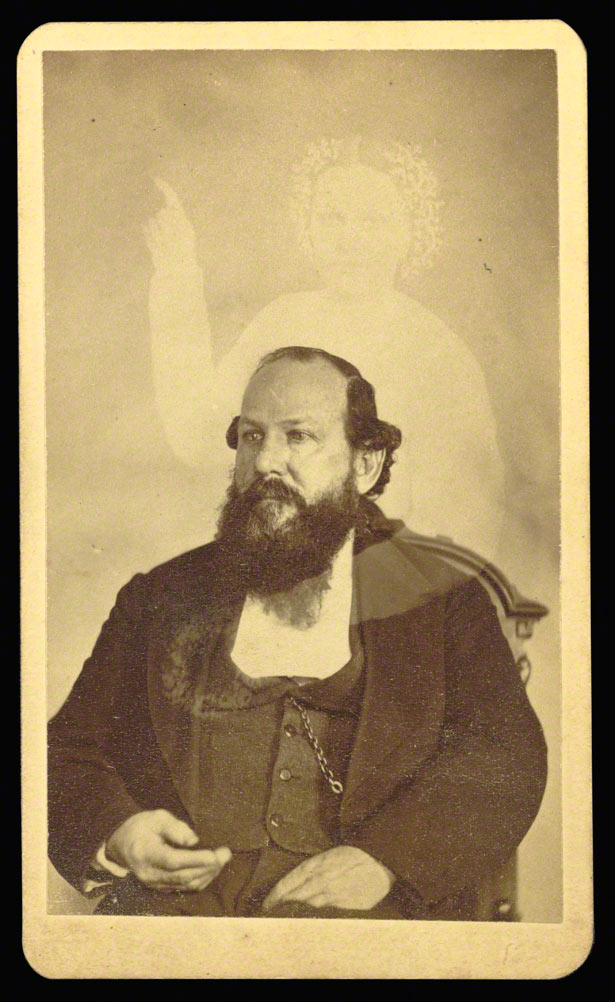
William Mumler was a
photographer in 1861 when a strange, shadowy figure appeared beside a
self-portrait he was developing. Friends of his noticed that it looked like a
dead cousin, and the photo soon attracted the attention of the spiritualist
community. They claimed this was the first instance of spirit photography, and
Mumler took advantage of this newfound interest in his business to become the
world’s first “spirit photographer.” Mumler took many portraits of people
which, when developed, showed a ghost or spirit near the sitter. He charged
exuberant prices for these sittings and often had people come back several
times before the spirit would show up in the negative. However, in addition to
attracting people who wanted photos with the spirits of their loved ones,
Mumler also attracted critics and skeptics. He went to court, charged with
fraud, but was acquitted. Soon he was making only pennies, a steep change from
the abundance he had been earning not long before. By 1879 Mumler had stopped
producing spirit photographs, but was still a believer in his spirit
photographs and destroyed his negatives shortly before he died in an attempt to
remove any doubt.[2]
The Loch Ness Monster
 |
| (source) |
Perhaps the most famous
photograph of the Loch Ness Monster is the Surgeon’s photo, taken on April 19,
1934 by Colonel Robert Wilson. Wilson refused to have his name associated with
the photo, and it came to be known as “the Surgeon’s photo.” It was not
seriously analyzed until 1984, when the British
Journal of Photography published an article in which the photo was analyzed
and the object in the water was concluded to be only two or three feet long. It
was not debunked until 1994, when Christian Spurling confessed to plotting the
whole thing with both Wilson and Marmaduke Wetherell, a big game hunter who had
tried to fake Nessie tracks in 1933 but failed. Spurling, Wetherell’s stepson,
had made a model of the Monster, which was then photographed in the Loch and
the resulting photograph given to Wilson who served as the front man. In the
original photograph, the far edge of the loch is visible and the small size of
the Monster model is apparent. The popular cropped photo, however, looks
more credible.[3]
UFO Photographs
 |
| (source) |
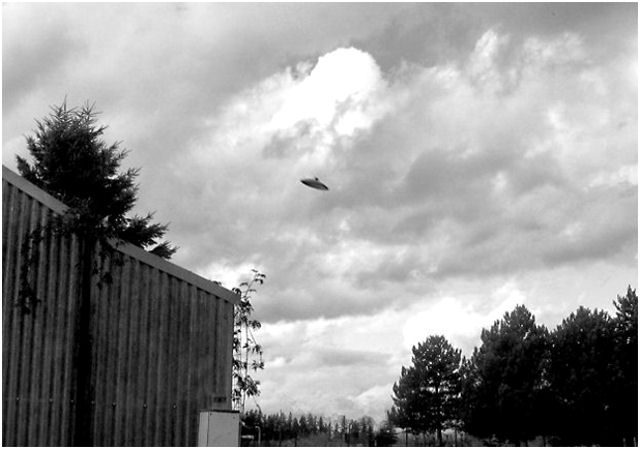
In May of 1950, Evelyn Trent
was feeding the rabbits on her family farm near McMinnville, Oregon, when she spotted a UFO and shouted
for her husband Paul, who ran outside with his camera and managed to take two
photos before the object flew out of sight. When the pictures were developed,
they created a local buzz that expanded into a nationwide interest. The photos
were even published in LIFE Magazine in June. The Trents claimed to have seen
UFOs in the area before, and insisted on the photograph’s authenticity. It has
been examined by several experts who were unable to prove that the image was a
hoax. The lighting shows that the object is not a hubcap hung on a telephone
wire, as some have claimed, but rather a distant object. Even an Air Force
investigation of UFO reports in 1967 determined that the evidence was “consistent
with the assertion that an extraordinary flying object, silvery, metallic,
disk-shaped, tens of meters in diameter and evidently artificial, flew within
sight of two witnesses."[4]
In addition to the photographs’ apparent authenticity, the actions of the
Trents surrounding the photographs leads many people to believe that this was
not a hoax—Paul Trent waited to finish the roll of film before developing it
(almost a month), the two photos are in the middle of the roll of film, and the
Trents never tried to take advantage of the photos or their publicity.[5]
“Staged” Photographs
 |
| (source) |
Joe Rosenthal’s iconic
photograph Raising the Flag on Iwo Jima was
claimed to have been staged. This was not the case—the confusion rose from
several different points: the fact that two flags were raised that day
(Rosenthal took the photograph of the second), and Rosenthal’s affirmative response
when asked if “the image” was staged (the image Rosenthal was referring to was
a group shot of all the soldiers, not the photograph of them raising the flag).
Even today, cries of staging still pop up, despite Rosenthal’s insistence on
the spontaneity of the photograph.[6]
 |
| (source) |
Roger Fenton’s “The Valley of
the Shadow of Death” is also claimed to have been staged. Two very similar
photographs exist of the valley—a shot with cannonballs strewn across the road,
and a shot without. Many people claim that the photograph without cannonballs
across the road was taken first, leading to the conclusion that Fenton took the
first photo and then moved cannonballs into the road to get a more striking
shot.[7]
Pierre Bourdieu writes that “Photography
is considered to be a perfectly realistic and objective recording of the
visible world because (from its origin) it has been assigned social uses that are held to be
‘realistic’ and ‘objective’.”[8]
We see reality reflected in photographs because we believe that reality can be reflected in photographs. We are
willing to believe in photos of young girls posing with fairies because we want
to believe. We are trained from our first encounters with photography to
believe that the camera doesn’t lie, that the photographs we take represent
reality as it is and nothing else, that photographs reveal truth more often
than they cover it up. Some contested photographs are never proven to be either
real or fake, but instead exist in a
liminal state, with proponents of each side arguing for the authenticity or
inauthenticity of a certain photograph.
The question becomes: how do we
define a “real” photograph? Is it still a “real” photograph if some details
have been altered, if some parts of the scene have been moved? Is it still a “real”
photograph if some people believe it’s fake and some people believe it’s true?
Is a “real” photograph one that contains a scene that is exactly how it was but
does not elicit any emotion in the viewer? Or is it one that has been cropped a
certain way, or taken from a slightly different angle, that removes some of the
context but brings up a very specific feeling? Hoax photographs are
traditionally looked down upon in the photography world, but for those people
who saw the photos of the Cottingley Fairies and believed them, or those who
had their portrait taken by Mumler and gained a sense of closure in seeing the
spirit of a loved one—even if those photos were
fake, does that make the emotions any less real? We don’t like to be tricked by
photography because we are trained to trust it implicitly, and as a result when
something is supposed to be “real” and turns out to be “fake,” we are
disappointed: we expected more. William Ivins writes that “the nineteenth
century began by believing that what was reasonable was true and it wound up by
believing that what it saw a photograph of was true – from the finish of a
horse race to the nebulae in the sky.”[9]
Our unwavering belief in the power of photographs as proof will continue to
cause confusion as more modern ways of doctoring and faking photos become more
accessible. Perhaps it is not the photographs who lie, but the people.
[1] Joe
Cooper, "Cottingley: At Last the Truth." The Unexplained,
No. 117, pp. 2338-40, 1982. http://www.lhup.edu/~dsimanek/cooper.htm
[2] The
ghost and Mr. Mumler. Historynet.com. http://www.historynet.com/the-ghost-and-mr-mumler.htm
[3] “The
Surgeon’s Photo,” The Museum of Hoaxes. http://www.museumofhoaxes.com/hoax/photo_database/image/the_surgeons_photo
[4] Kelly
Kennedy, “McMinnville UFO Photos 50
Years Later - Still A Mystery.” The
Oregonian. May 12, 2000. http://rense.com/general/mcmin50.htm
[5]
Pat Forgey, “McMinnville Photos 50
Years Later.” The News-Register,
McMinnville, Oregon. December 2000. http://rense.com/general/mcmin50.htm
[6]
Mitchell Landsberg, “Fifty Years Later,
Iwo Jima Photographer Fights His Own Battle.” http://web.archive.org/web/20040412081346/http://www.ap.org/pages/about/pulitzer/rosenthal.html
[7]
Errol Morris, “Which Came First, the Chicken or the Egg?” The New York Times. September 25, 2007. http://opinionator.blogs.nytimes.com/2007/09/25/which-came-first-the-chicken-or-the-egg-part-one/
[8] Pierre
Bourdieu, “The Social Definition of Photography” in Visual Culture: The Reader, edited by Stuart Hall & Jessica
Evans. London: SAGE Publications in association with the Open University, 1999;
p. 162.
[9]
Quoted in Jennifer Tucker, "Science Illustrated: Photographic Evidence and
Social Practice in England, 1870-1920."The Johns Hopkins University, 1997.
In PROQUESTMS ProQuest Dissertations & Theses (PQDT),
http://0-search.proquest.com.library.simmons.edu/docview/304348034?accountid=13870.,
p. 4.

No comments:
Post a Comment