Eastman gelatin film, or Eastman paper stripping negatives, were invented in 1886 by George Eastman, founder of Eastman Kodak. Eastman became interested in making photography more mobile and accessible after preparing to take photographs on a summer trip to Santo Domingo (that subsequently didn't happen) and discovering that the process was much more complicated and cumbersome than he expected. He developed a dry plate process as a counter to the wet plate process and began selling those in 1880. Once he launched the Eastman Dry Plate Company, he continued experimenting with developing a more flexible film base that would make photographic equipment much more portable (
University of Rochester Libraries).
To make a paper stripping negative, a paper base was coated with a layer of soluble gelatin and a gelatin emulsion. Then:
After the images were exposed, developed, and fixed, the roll of paper negatives was pressed face down on a coated glass plate. Hot water was applied to the paper back. This melted the soluble gelatin layer, allowing the paper to be removed and leaving the negative emulsion on the glass plate. A thin sheet of fresh gelatin was moistened and pressed on the back of the roll of negatives and allowed to dry. The roll of negatives, now supported by clear gelatin instead of paper, was then removed from the glass plate as one unit. The negatives were then printed (P:ACM, p. 44-45).
The film negatives were still fairly fragile, especially compared to the more contemporary plastic negatives, but using gelatin solved the fragile (and weighty) glass plate negative problem. It also solved the problem of using one plate per exposure and needing to reload with a new negative after every shot—now photographers could simply advance the film in the camera to take another picture immediately. The ease of use allowed amateur photography to bloom, and the complicated printing procedures were eliminated for the users:
The KODAK camera, pre-loaded with enough film for 100 exposures, could be easily carried and handheld during operation. It was priced at $25. After exposure, the whole camera was returned to Rochester. There the film was developed, prints were made and new film was inserted -- all for $10. (Kodak.com)
Eastman Kodak also advertised very strongly for these cameras, with the catchy slogan "you press the button -- we do the rest" (see below). The negatives had circular image areas, and prints were round and mounted on square mats.
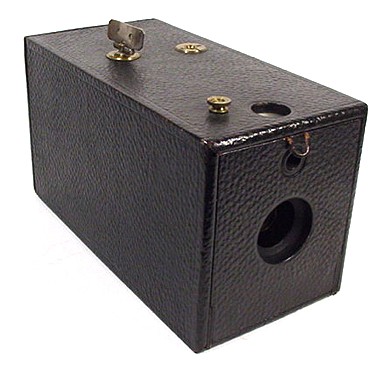
Images from the Kodak no. 1 camera (1888) were 2 ½ inches in diameter, and images from the Kodak no. 2 camera (1889) were 3 ½ inches in diameter (P:ACM p. 45-46). Examples of cameras and prints are below.



No comments:
Post a Comment