Cyanotypes
The cyanotype was invented in the mid-19th century,
but came to prominence a bit time later and remained popular up until 1920.
Cyanotypes can be easily identified by their blue tint. This blue color, called
Prussian blue, develops from the mixture of chemicals placed on a
photosensitive surface, upon which is placed the object to be photographed,
covered with a sheet of glass, and is then exposed to light. Once the paper is
exposed, it is washed in water; everything but the iron residue, or Prussian
blue, is washed away, bringing out the image with its identifiable blue tint (http://www.getty.edu/art/gettyguide/artObjectDetails?artobj=71365).
Cyanotypes are most often seen on paper, but can be put onto a number of
different materials, like fabric and wood.
Sir John Herschel developed the cyanotype process in
1842; he meant the cyanotype to be used mainly as a means of reproducing notes
and diagrams. Anna Atkins can be
credited with bringing the cyanotype to prominence as a form of photography
with the publishing of her book, British
Algae: Cyanotype Impressions in 1843; this was the first photographically-illustrated
book to be published (Ware 2004).
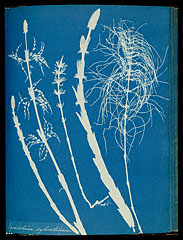

J. Paul Getty Museum
While most well-known for use in botanical
photography by people like Anna Atkins, cyanotypes were primarily taken by
amateur photographers between 1880 and 1920, which lends a note of interest to
their subjects and compositions. This was an inexpensive way for amateur
photographers to perfect their art, and the subjects of cyanotypes from this
time period are varied, though many depict daily human life (http://www.consortiumlibrary.org/blogs/archives/2010/08/23/photos-in-the-archives-cyanotypes/).

Native
Alaskan couple
Archives
at the UAA/APU Consortium Library
The cyanotype process was very popular with
engineers, as it could be used to reproduce large-scale copies of their works,
otherwise known as blueprints. The blueprint process never changed from its
inception in 1842, and was only made obsolete when recently replaced with the widespread
use of photocopiers.
Cyanotypes have very interesting preservation and
conservation needs. It is not recommended to place cyanotypes on or near
traditional acid-free museum stock, as the paper can cause degradation of Prussian
blue, which does not like alkaline environments. Fading cyanotypes can actually
be restored to almost full color by allowing them to sit in a dark space. The Connecticut
State Library says that a " faded cyanotype might
be restored if put back in a dark, airy, well-humidified environment for 5 days
and then move it to a dark, airy, drier environment" (http://www.cslib.org/PresTakingCare.htm).
And in case you're interested, here's a link to a video
showing how to make a cyanotype! http://www.youtube.com/watch?v=9q8N_KgH8SI
http://www.consortiumlibrary.org/blogs/archives/2010/08/23/photos-in-the-archives-cyanotypes/
http://www.cslib.org/PresTakingCare.htm
http://www.getty.edu/art/gettyguide/artObjectDetails?artobj=71365
Ware, Mike. Ag+ Photographic. Vol 7, pp 74-81.
1995, Revised 2004.
Magee, Spike. "Cyanotype history- John Herschel's
Invention." http://www.alternativephotography.com/wp/history
/cyanotype-history-john-herschels-invention. Accessed 18 October 2012.

No comments:
Post a Comment